
Jewish Culture Month: on birth, continuity and community
At our recent Jewish Birth & Life Cycles event, Rabbi Charley Baginsky offered a thought-provoking reflection on birth, continuity and the role we each play in shaping the future of Jewish life. Our sincere thanks to Rabbi Charley for her contribution to the day. We are delighted to share her speech in full below.
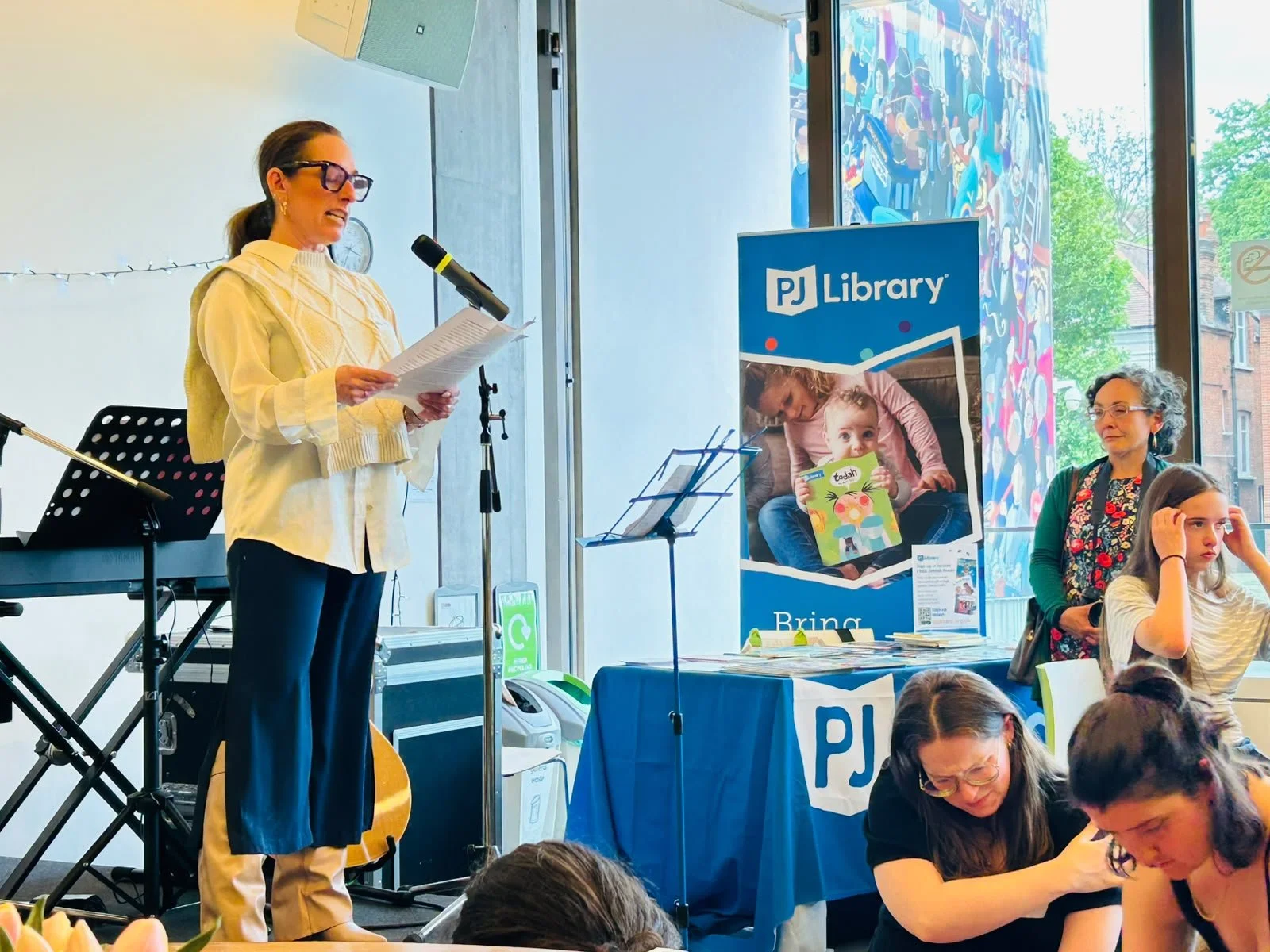
Rabbi Charley Baginsky speaking at Jewish Birth and Life Cycles: An afternoon of story and celebration, part of Jewish Culture Month.
For a tradition so committed to continuity, Judaism spends remarkably little time idealising the process by which continuity happens.
The Bible is full of infertility, difficult pregnancies, family conflict, grief, longing and disappointment. Sarah laughs at the prospect of motherhood. Rachel cries out, "Give me children, or I shall die." Hannah prays silently in the sanctuary, so distressed that Eli mistakes her anguish for drunkenness. The Jewish story begins with people navigating uncertainty rather than certainty, vulnerability rather than confidence.
And yet Judaism remains stubbornly committed to the future.
Perhaps that is why this event feels so at home within Jewish Culture Month. When we speak about culture, we often think about books, music, theatre, food or art. And of course culture includes all of those things. But at its heart, culture is what a community decides is worth passing on. It is the stories we tell, the experiences we honour and the values we place into the hands of the next generation.
For all the ways Jews are described as a people of memory, I have always thought we are equally a people of futurity. We carry our past with us, but Judaism is never interested in memory for its own sake. Memory matters because it shapes responsibility. The question Judaism asks, over and over again, is not simply where have you come from, but what are you going to do with what you have inherited?
That question sits at the heart of today's gathering.
It is also impossible to separate it from the experiences of women. So much of what we call continuity has historically depended upon women's labour, women's care, women's bodies and women's wisdom, yet those experiences have not always been given equal space within our
communal narratives. We inherited the stories of Sarah, Rebecca, Rachel, Leah, Miriam and Hannah, but we have not always listened carefully enough to their voices. The Jewish story has often remembered what women did without always asking what women knew.
Perhaps that is one reason why gatherings like this matter. They create space not only to celebrate birth and parenting, but to hear experiences that have too often been treated as private when they are, in fact, deeply communal. They remind us that the story of Jewish continuity cannot be told solely through institutions, texts and leaders. It is also told through care, through relationships, through families and through the often unseen work of sustaining life itself.
For all the centrality of birth, family and continuity within Jewish life, many of the experiences surrounding them have often remained strangely hidden. We celebrate arrivals and milestones, but the journeys that precede them are frequently left unspoken. Infertility, miscarriage, pregnancy loss, difficult births, adoption, guardianship, chosen family and the countless ways people create, nurture and sustain life deserve a place within our communal story.
One of the things I admire most about Shifrah is its insistence that these experiences belong at the centre of our communal conversation. They are not exceptional stories. They are deeply human ones.
That feels particularly important now.
Many Jews are carrying profound anxieties. Antisemitism has risen sharply. Public discourse feels increasingly brittle and polarised. Many people are asking difficult questions about what kind of world we are handing to our children and grandchildren, and what it means to raise Jewish children in this particular moment.
Those questions are also being carried by many Jewish healthcare professionals, including those working in maternity services, whose vocation is to care for others at moments of profound vulnerability. Over recent years we have heard from Jewish midwives, doctors and nurses who have found themselves navigating hostility and misunderstanding in workplaces that ought to be places of safety and dignity for all. Their experiences remind us that antisemitism does not simply affect Jewish institutions. It reaches into schools, hospitals, universities, workplaces and the everyday encounters through which people make sense of the world.
Judaism's response to uncertainty has never been withdrawal. The commandment is u'vacharta ba-chayim — choose life.
That is a demanding proposition. It asks us to invest in the future when the future is uncertain. It asks us to create families, communities, institutions and relationships despite knowing they will bring both joy and heartbreak. It asks us to believe that tomorrow matters enough to shape.
Perhaps that is why the presence of Shifrah and Puah at the beginning of the Exodus story feels so significant. Before Moses is born, before the sea parts, before liberation begins, there are two midwives. Two women who
understand that protecting life is itself an act of resistance and that safeguarding possibility is a form of courage.
I often think we do not spend enough time reflecting on that. The story of Jewish liberation begins with women whose work is care, whose courage is moral and whose commitment is to the future. They understand that history is changed not only by those who hold power but by those who make life possible.
At a moment when women's autonomy, expertise and authority are once again being contested in many parts of the world, there is something striking about the fact that the Torah begins its great story of freedom by
placing its trust in women. Before there are prophets, priests or kings, there are midwives.
The poet Adrienne Rich wrote that "there must be those among whom we can sit down and weep and still be counted as warriors." I have always loved that line because it captures something of what I hope spaces like this can offer. Communities where people can bring the fullness of their stories, and where vulnerability is recognised as a source of strength rather than a sign of weakness.
And because this is Jewish Culture Month, I want to return to the idea of culture itself.
Culture is a living conversation between generations. Every blessing we write, every ritual we adapt and every difficult story we finally allow to be heard becomes part of that conversation.
Joni Mitchell sang that we are "captive on the carousel of time". Judaism offers a slightly different image. We are shaped by those who came before us and responsible for those who will come after us. Every generation inherits a world unfinished. Every generation must decide what it will add to the story.
That, it seems to me, is what today's gathering is really about.
It is about birth and parenting, certainly. It is about families and care. But it is also about continuity, responsibility and imagination. It is about having the courage to tell the truth about human experience in all its complexity, and about asking what kind of Jewish culture we are creating for those who will come after us.
Thank you for being here. Thank you for bringing your experiences, wisdom and stories into this room. And thank you to Shifrah for creating a space where some of life's most profound transitions can be explored with honesty, compassion and depth.
Because if Jewish culture teaches us anything, it is that the future is something we create together.